Verify insurance the right way
Ask for both general liability and workers' compensation, and ask for the certificate to come from the carrier rather than as a forwarded PDF. A printout can be expired or edited; a carrier-issued certificate cannot.
This is not paperwork theater. If an uninsured worker is hurt on your property, or an uninsured crew drops a limb through your roof, that exposure can land on your homeowners policy.
Get the scope in writing before anyone climbs
A real estimate names the trees, describes what will be done to each one, and states what happens to the debris and the stump. 'Trim trees — $X' is not a scope; it is an argument waiting to happen.
It should also say who is responsible for cleanup, whether the stump is included, and what the crew will do if they find something unexpected once they are in the canopy.
Red flags worth walking away from
- Offers to top your trees, or uses the words 'top' and 'prune' interchangeably
- Door-knocking the day after a storm with a truck and a large cash discount
- Demanding full payment up front, or cash only with no written scope
- Cannot produce a carrier-issued insurance certificate
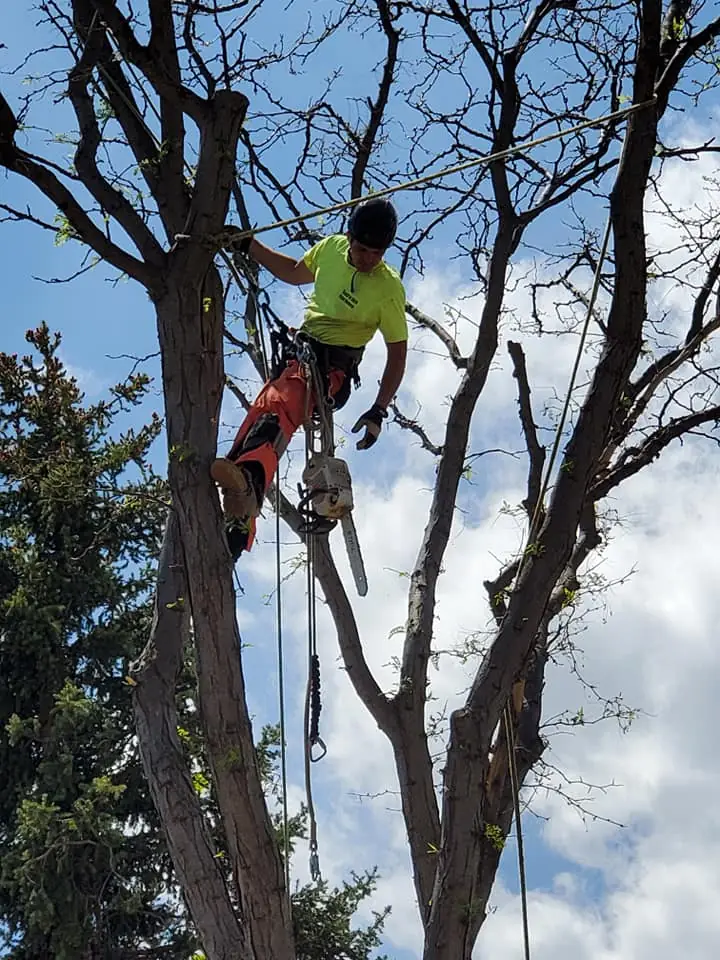
- Climbing with spikes on a tree that is being pruned, not removed
- No mention of ANSI A300 or industry safety practice anywhere in the conversation
- Pressure to decide on the spot before you get a second opinion
Ask about standards, not just price
ANSI A300 is the pruning standard and ANSI Z133 is the safety standard. A company that works to them will tell you which pruning type they are performing — crown cleaning, thinning, raising or reduction — instead of 'a trim'.
Ask what percentage of live canopy they plan to remove. A confident answer in the modest range is a good sign; 'as much as it needs' is not.
Local knowledge is not a soft factor here
Front Range tree care is specific: alkaline soil and iron chlorosis, emerald ash borer pressure, wet spring snow loading, canyon wind in Golden, and irrigation-dependent trees that decline the year a sprinkler zone fails.
A crew that works Arvada, Wheat Ridge and Lakewood every week already knows which species fail in which storm, and prices access on tight lots accurately instead of guessing.
Judge the cleanup as part of the job
Ask specifically: is brush chipped, are logs hauled, are ruts raked, is the driveway blown clean? Cleanup is where cheap bids quietly cut scope, and it is what you will actually be looking at for the next month.
Questions we get
Do tree companies in Colorado need a license?
Requirements are set locally rather than statewide. Denver, for example, requires a licensed contractor for work on public right-of-way trees. Insurance and demonstrated standards matter everywhere.
Should I get multiple quotes?
Yes, and compare scopes rather than just totals. The cheapest bid is often cheapest because it excludes stump work, haul-away or cleanup.