
The physics of a Front Range spring storm
March and April snow here lands wet and heavy, and it lands on trees that have already leafed out or pushed buds. Leaves and blossoms catch snow the way bare winter branches never do, and the load multiplies.
Add the temperature swinging around freezing so the snow sticks rather than sliding off, and a mature silver maple can be carrying thousands of pounds it was never structurally built to hold.
The trees that fail first
Failures are not random. They happen at predictable structural defects that an arborist can spot in January.
- Co-dominant leaders with included bark — two trunks that never fused, which split down the middle
- Silver maple and Siberian elm, which grow fast with weak wood
- Bradford and callery pear, notorious for tearing out at the union
- Young autumn blaze maples in newer Westminster and Candelas subdivisions with two competing leaders
- Overextended limbs with heavy end weight and no interior branching
- Ash weakened by borer, which snaps rather than bends
What actually prevents it
Structural pruning in late winter — reducing end weight on overextended limbs, subordinating one of two competing leaders, and removing deadwood — is the single highest-return tree investment on the Front Range. It is cheap relative to an emergency takedown plus roof repair.
Cabling and bracing can support a union that is too large to correct with cuts. It is not a substitute for pruning, but on a valuable mature tree it buys years.
During the storm: what to do and what not to do
Do not go out with a broom or a ladder to knock snow off branches, and do not stand under a loaded canopy. Frozen wood is brittle and limbs release without warning.
Stay away from anything touching a power line and call the utility, not us. Assume every downed line is live.
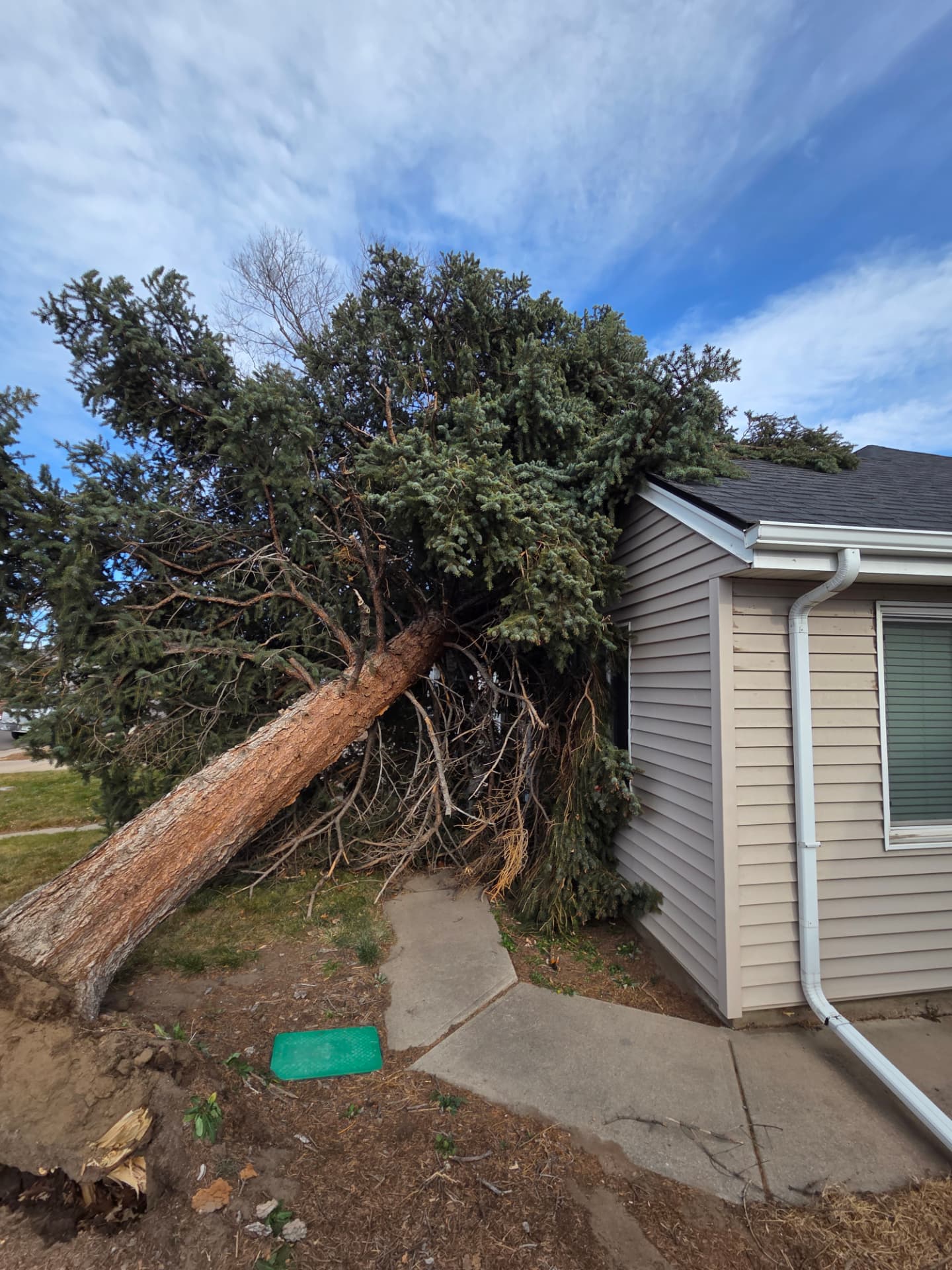
Photograph damage before anything is moved — insurers want to see the tree where it landed.
After the storm: triage order
Hung and partially attached limbs over walkways, driveways and roofs come first — those are the actual danger. Debris on the lawn can wait a day.
Resist the impulse to have every broken tree removed. Many trees with one failed leader can be reduced and kept. We tell you which ones honestly, because we would rather prune your tree twice over the next decade than remove it once.
Questions we get
Will insurance cover storm tree damage?
Insurers generally cover damage to covered structures and the removal needed to address it, and generally do not cover simple yard cleanup. We document the scene with photos and provide written scopes suitable for a claim.
Can a split tree be saved?
Sometimes. A single failed leader on an otherwise sound tree can often be reduced and the wound left to seal. A split through the main union usually cannot be saved safely.