Why this matters more here than almost anywhere
Ash was planted heavily across metro Denver from the 1970s through the 1990s. In whole Arvada, Wheat Ridge and Lakewood subdivisions, ash is not one tree in the yard — it is most of the canopy on the street.
Emerald ash borer is established in the region, and an untreated ash does not slowly decline and stabilize. It thins from the top down and dies, then becomes brittle enough that removal gets more dangerous and more expensive every season.
Is it even an ash?
Check three things: opposite branching (limbs directly across from each other), compound leaves with five to nine leaflets, and diamond-patterned bark on mature trunks.
Mountain ash is not a true ash and is not affected. Neither is elm, honeylocust or boxelder — though boxelder shares opposite branching and confuses people constantly.
The signs, in the order they usually appear
- Thinning and dieback starting at the top of the canopy, not the bottom
- Heavy woodpecker activity and pale 'flecking' where bark has been chipped away
- D-shaped exit holes about an eighth of an inch across
- S-shaped larval galleries packed with sawdust under loose bark
- Epicormic sprouts — shoots pushing straight out of the trunk and root flare
- Vertical bark splits over old galleries
Treat or remove: the honest threshold
Treatment protects a canopy that is still largely intact. If the crown is full and dieback is limited, a trunk-injection program on a repeating cycle is usually well worth it — a mature shade tree in a Front Range yard is worth real money in cooling, property value and shade you cannot replace for twenty years.
Once roughly a third or more of the canopy is gone, the tree's vascular system has already taken too much damage. At that point treatment is spending money on a tree that will still come down, just later and at higher risk.
If you treat, treat properly
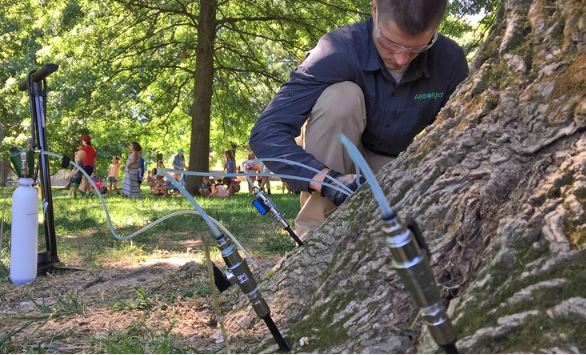
Trunk injection dosed by trunk diameter is the dependable option under real borer pressure, repeated on a cycle rather than once. Budget for the cycle.
Soil-applied products are cheaper and appropriate for low-value trees you are willing to lose. They are not what we recommend for the tree shading your patio.
If you remove, plant for the next fifty years
Grind the stump, backfill with topsoil, and replant a few feet off center with something that spreads your risk — Kentucky coffeetree, hackberry, bur oak, catalpa or a native-adapted maple suited to alkaline Front Range soil.
The lesson of ash is monoculture. Two different species in the yard is cheap insurance.
Questions we get
Can a heavily infested ash be saved?
Realistically, no. Once the upper canopy is a third or more gone, the tree has lost too much vascular tissue. Removal while the wood is still sound is the safer and cheaper path.
Do I have to treat if my neighbor's ash is infested?
If you want to keep your ash, yes. Borer pressure is regional, and an untreated ash on a street with infestation is a matter of when, not if.