Tree Removal in Arvada, CO
Dead, hazardous or crowding trees taken down in controlled sections — with every branch, log and chip hauled away. Serving Arvada and the rest of Denver West.
Tree Removal for Arvada homeowners and property managers
Most Arvada removals we run are borer-killed ash in the Lake Arbor and Ralston Valley subdivisions, or cottonwoods along the ditch lines that are now taller than the houses they shade.
Dead ash, storm-split silver maples and oversized cottonwoods are the three takedowns we do most. Our climbers rig and lower each section over fences, sheds and power drops instead of dropping whole trees, then haul everything out and blow the yard clean before we leave.
- Serving
- Arvada, CO
- Jefferson County
- Estimate
- Free & written
- Fixed scope before work starts
- Scheduling
- Usually same week
- Usually same-week, and often next-day for hazard calls since we stage equipment in Arvada.
The trees we see most in Arvada
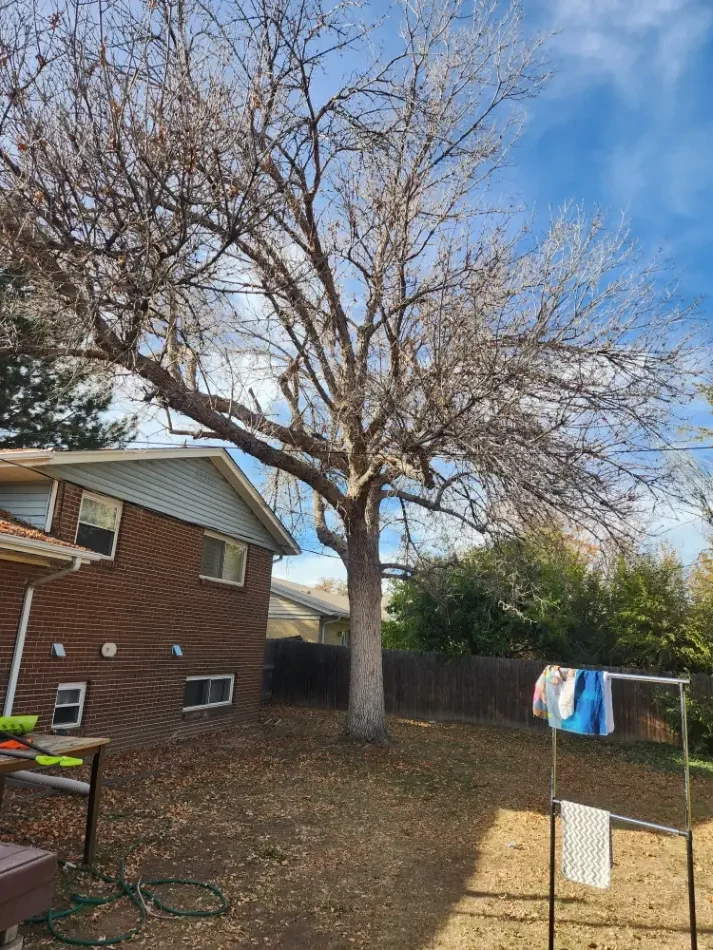
Arvada canopy is dominated by green and white ash through the 1970s–90s subdivisions, silver maple and Siberian elm in Olde Town, and ditch-corridor cottonwoods that outgrew their yards. That shapes how we approach tree removal here rather than applying one generic method everywhere.
Arvada is home base, so our trucks are usually already on your side of town. Older Olde Town lots have narrow alleys and detached garages, while Candelas and Leyden Rock have tight side yards and new sod we mat before dragging brush.
The three Arvada removals we run most weeks
Roughly half of the removals we quote in Arvada are ash killed by emerald ash borer. Arvada planted green and white ash heavily through the 1970s, 80s and 90s, so entire blocks in Lake Arbor, Ralston Valley, Woodland Valley and Scenic Heights went in at the same time and are now failing at the same time. A borer-killed ash gets brittle fast: within two seasons of the canopy thinning, the limbs snap under their own weight instead of bending, which changes how we climb it and often pushes us into the bucket truck instead of a saddle.
The second group is silver maple and Siberian elm in the older streets around Olde Town and Ralston Road. These were fast-growth shade trees planted close to houses, and they usually have two or three co-dominant stems with included bark at the union. When one of those stems tears out — almost always in a wet March or April snow — what's left is unbalanced and has to come down rather than be trimmed back.
The third is ditch-corridor cottonwood. Along the Ralston Creek and Farmers' High Line canal corridors there are cottonwoods that were seedlings when the yards were laid out and are now 70 to 90 feet with limbs the size of ordinary trees. Those are crane or heavy-rigging jobs, and we plan them around the ditch easement and neighbors' property rather than dropping anything.
How we take a tree down in an Arvada backyard
The typical Arvada lot gives us a fence, a shed, a service drop to the house and about ten feet of clearance. So almost nothing gets felled. A climber ties in, sets rigging above the piece being cut, and every limb and log section is lowered on rope to a groundman in the drop zone. Larger stems come off in short spar pieces so nothing swings into a fence or a neighbor's roofline.
Where the bucket truck can reach — front yards, corner lots, alley-accessible blocks in Olde Town — we use it, because a lift is faster and safer than climbing a dead ash. Where it can't, our climbers work the tree on rope and saddle. For the biggest cottonwoods and for anything leaning over a house, we bring in a crane so the weight is held before the cut is finished rather than after.
Xcel service drops are the thing that changes plans most often in Arvada. If the tree is over the secondary drop to the house, we schedule a temporary disconnect before the crew shows up instead of working live wire clearance. If a primary line is involved, that's a utility job first and ours second, and we'll tell you that during the estimate rather than on the morning of the work.
Cleanup, the stump, and what your yard looks like after
Everything we cut leaves with us: logs, brush and chips are loaded and hauled the same day unless you want the wood bucked and stacked, which we'll do at no extra charge if you ask during the estimate. Drag paths across turf get matted or plywood-protected on soft spring ground so we aren't leaving ruts across a lawn you just started watering.
The stump is a separate decision, not an assumption. If you want it gone we grind 6 to 8 inches below grade, chase the surface roots that heave sod, and leave the grindings on site to backfill or haul them off and bring in topsoil so the spot is ready to re-sod, replant or pour. Before the grinder rolls we call in utility locates, because a lot of Arvada's older subdivisions have shallow sprinkler mains and gas runs near where trees were planted.
Last thing before we pull out: the drive, sidewalk and lawn get blown clean and we walk the job with you. The written price you signed is the price you pay — we don't add a line item after the fact because the trunk was bigger than it looked from the ground.
Permits, HOAs and property lines in Arvada
Trees on your own Arvada property don't require a city permit. The exception is the right-of-way strip between the sidewalk and the curb: those trees are managed by the City of Arvada's forestry program and need approval before removal. We file that request as part of the job rather than handing you a form.
Newer Arvada communities — Candelas, Leyden Rock, Whisper Creek — have HOA landscape rules and sometimes require replacement plantings after a removal. We'll tell you what we've run into on those streets, but the HOA approval itself stays with you as the homeowner. For a tree on or near a property line, Colorado treats a boundary tree as jointly owned, so we ask that both neighbors agree in writing before we cut. It takes one conversation up front and prevents a real problem later.
What's included with tree removal in Arvada
- Licensed and fully insured — certificate provided before work starts
- Sectional rigging near fences, roofs and power lines
- Dead, diseased and emerald ash borer removals
- Storm and hazard takedowns
- Complete brush, log and debris haul-away
- Optional same-visit stump grinding
How a Arvada job runs, start to finish
- 01
Free on-site assessment
We walk the tree, check access, and give you a firm written price — no pressure and no surprise add-ons.
- 02
Site protection
Drop zones are marked, turf and hardscape are matted, and vehicles and furniture are moved clear.
- 03
Controlled takedown
Limbs are rigged and lowered in sections, then the trunk is bucked from the top down.
- 04
Cleanup
Brush chipped, logs hauled, work area raked and blown clean before we pull out.
Permits and Arvada rules
Trees on private property in Arvada do not need a permit. Right-of-way trees between the sidewalk and street are city-managed and need approval first — we file that for you.
Arvada neighborhoods we cover
- Olde Town Arvada
- Lake Arbor
- Ralston Valley
- Candelas
- Leyden Rock
- West Woods
- Arvada West
- Whisper Creek
Tree Removal in Arvada: common questions
How much does tree removal cost in Arvada?
It depends on height, trunk diameter, what's under the tree and whether a bucket truck can reach it. A small dead ash in an open front yard is a fraction of a 75-foot cottonwood that has to be craned over a house. We give a free written estimate with a fixed scope and price before any work starts, so nothing moves after the crew arrives.
Do I need a permit to remove a tree in Arvada, CO?
Not for trees on private property. Trees in the public right-of-way — generally the strip between the sidewalk and the street — are city-managed and need approval from Arvada first. We handle that request for you.
My ash tree still has leaves. Does it have to come out?
Not necessarily. If less than about a third of the canopy is thin and the tree is otherwise structurally sound, trunk-injection treatment on a two-year cycle is usually the cheaper long-term choice. Past that point treatment stops being worth the money and we'll say so.
How fast can you get out for a hazardous tree?
Arvada is our home base, so standard removals are usually scheduled within the same week and hazard calls — a leaning trunk, a split leader hanging over a roof — are often next-day. Storm damage gets same-day response.
Will your equipment damage my lawn or driveway?
We mat drag paths and use plywood under wheels on soft ground, keep the chipper on the drive or street where possible, and blow everything clean before leaving. We carry full liability and workers' comp insurance, and we'll send the certificate directly to you or your HOA on request.
What do you do with the wood?
It leaves with us by default. If you heat with wood, tell us at the estimate and we'll buck the trunk into rounds and stack them where you want them at no extra cost. Ash from a borer-killed tree should stay local rather than travelling out of the quarantine area.
Other tree services in Arvada
Tree Trimming & Pruning in Arvada
Correct cuts that improve structure, clear your roof and let Front Range wind pass through the canopy — never topping.
Stump Grinding in Arvada
Stumps ground well below grade so you can re-sod, replant or reclaim the space — chips hauled or backfilled, your call.
Emergency Tree Service in Arvada
Split trunks, limbs on the roof, trees across the drive — fast on-site response with photos and documentation for your claim.
Tree Health & Plant Care in Arvada
Comprehensive tree care, plant health management and pest/disease treatment in Arvada and Wheat Ridge — keeping your trees healthy and your landscape looking its best.
Tree Removal in nearby cities
See everything we do in Arvada or read the full tree removal overview.
Tree Removal in Arvada?
Licensed, insured and local — free written estimates and complete cleanup.